
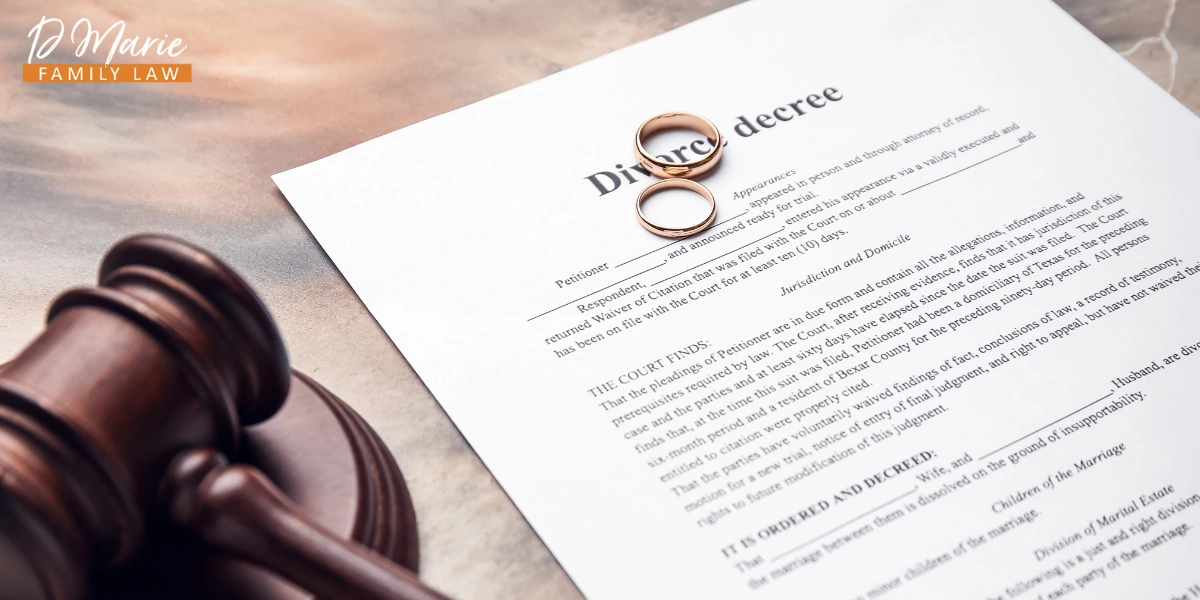
A: The total cost of a divorce lawyer in Texas depends on several factors, like how experienced your attorney is and the amount of time it takes to solve your case. Attorneys may charge a premium when they have a history of winning cases that will benefit their new clients. The longer they need to spend on your case, the more you might be required to pay. For this reason, uncontested divorces may cost less than divorces with disputes.
Sugar Land Divorce Lawyer
Sugar Land Divorce Attorney
Making the decision to enter a divorce is a life-changing moment for all involved. It can bring forth many different emotional and legal challenges that are difficult to manage alone. Whether the divorce is amicable or riddled with contested issues to resolve, having the right support can make a huge difference in achieving a fair resolution. Hiring a Sugar Land divorce lawyer can be that resource you need to protect your rights and help you move forward with confidence.
At D Marie Family Law, our attorney, Donnica Marie Blackful, sees divorce as more than just a legal process to manage. It’s a deeply personal journey that her clients trust her to help them resolve. She is dedicated to guiding you through every part of the process, from filing paperwork to negotiating with your spouse’s counsel and advocating for your interests in court. At every step, she can help you make the transition into your independent life as smooth as possible.
Contact D Marie Family Law today to schedule a consultation and get compassionate, skilled support through your divorce journey.
Demand Results in
Your Family Law Matter
You’re not just looking for a lawyer; you’re seeking results. Donnica Marie Blackful delivers focused legal strategies and relentless advocacy to pursue your objectives and achieve the resolution you need. Get the direct action you deserve.
Call Us Today!
281-895-3776
Types of Divorce Handled
All divorces can be broken down into two broad categories:
- Uncontested divorces. Uncontested divorces occur when two spouses are in general agreement about how their divorce should move forward. You must come to an agreement with your spouse regarding essential elements of the divorce, such as child custody, child support, spousal support, and property division. Mediation can be helpful to resolve certain types of disputes without going to court.
- Contested divorces. Contested divorces occur when two spouses cannot come to a consensus on one or more of the important provisions of their divorce agreement. When this occurs, the proceedings must be taken to court, where a judge can rule on contested issues.
Uncontested divorces generally take less time to resolve and may have lower attorneys’ fees than those that must go to court for a full resolution.
Divorces can also be broken down into other types of categories. We handle:
- High-net-worth divorces. We can help you with the division of complex assets, which may require business valuations, Qualified Domestic Relations Orders, valuing real estate, and uncovering hidden assets. We can also help you resolve issues pertaining to child support and spousal support. The state caps the monthly resources used to determine standard child support requirements, which could have an impact on your case.
- Military divorces. The state combines its community property rules with the provisions of the federal Uniformed Services Former Spouses’ Protection Act (USFSPA) to determine how payments are divided during military divorces. Active duty deployment can impact child custody proceedings, but cannot be the only reason to deny child custody. This can have a significant impact on Texas’s 115,000 to 118,000 active-duty service members.
- International divorces. International divorces are handled by filing through the Fort Bend County Justice Center, provided that at least one spouse meets the state’s residency requirements. The overseas partner can then be served divorce papers through proper international channels. Citizenship status does not matter in Texas divorces. Temporary work visas and non-citizens meeting the state’s residency rules can file for divorce here.
If you have questions regarding a complex divorce case, we can leverage our deep knowledge of local divorce laws to answer them. Feel free to schedule a consultation to voice your concerns. We can help you find a way to move forward.
Fault-Based vs. No-Fault Divorces in Texas
The Lone Star State recognizes both no-fault and fault-based grounds for divorce. Insupportability is the most frequent cause for a no-fault divorce in Texas. This simply means that the union has crumbled due to personal conflict and that there is no reasonable hope for resolution between the parties, but there is not necessarily any abuse or wrongdoing on the part of either spouse.
Fault-based divorces are approached differently. Under Texas Family Code 6.002-6.008, the following fault-based grounds may be recognized:
- Cruelty. If one spouse engages in cruel treatment toward the other that renders living together insupportable, it’s considered a fault-based ground for divorce.
- Adultery. If one spouse can show that the other has committed adultery, they may be able to file for a fault-based divorce.
- Conviction of a felony. The court can grant a divorce in favor of one spouse if the other one is convicted of a felony during the marriage and is subsequently imprisoned for at least one year. This provision does not apply to situations where one spouse was convicted on the testimony of the other spouse.
- Abandonment. Abandonment occurs if one spouse left the other with the intention of abandoning them and remained away for at least one year.
- Living apart. If two spouses have lived apart for at least three years, the court may grant a fault-based divorce.
- Confinement in a mental hospital. A divorce may be granted in favor of one spouse if the other has been confined to a mental hospital for at least three years and it appears that adjustment is unlikely.
Filing for a fault-based divorce can have a direct impact on the final legal and financial terms of the dissolution of your marriage. You may:
- Receive a larger share of the marital assets.
- Become eligible for spousal support.
- Receive custody of a child.
If you’re not sure whether to file for a fault-based or a no-fault divorce in Texas, we can help you determine the most effective way to move forward while protecting your rights and interests and helping you meet your financial goals.
What Decisions Need to be Made in a Texas Divorce?
Sugar Land, Texas, located in Fort Bend County, handles divorce cases through the Fort Bend County District Courts. To file for divorce, one spouse must have lived in Texas for at least six months and in the county for 90 days. Divorce proceedings include a mandatory 60-day waiting period before finalization, allowing time for reconsideration. Cases may involve child custody, property division, and spousal support, with courts emphasizing fair resolutions.
There are many different decisions to be made during the divorce process in Texas that can significantly impact your future. Each decision requires careful consideration and collaboration with a family lawyer like D Marie Family Law who knows the ins and outs of divorce and family law in Texas.
Some of the most common decisions that you might have to make in your own case include:
Division of Property and Debts
Texas is a community property state. This means that most property and debts that have been acquired during the course of a marriage could be subject to division. For fair property division, you may need to work with an attorney to identify what assets are considered separate property and which are jointly owned.
You must then need to get an evaluation of each asset to determine its fair market value. This can help the courts decide on a division of assets that makes the most sense.
Child Custody and Visitation
For any divorcing couple who also have children together, decisions will need to be made regarding custody of the children. This can either be a joint arrangement, meaning both parents share time and decision-making, or the responsibilities can be granted to one parent. If sole custody is issued, the non-custodial parent could be awarded visitation time unless there is evidence that they have abused the child in the past or have a history of neglect.
Child Support
Child support is another critical decision for divorcing parents with children. Texas law requires any non-custodial parent to pay child support to help the other parent cover the child’s most basic needs, such as shelter, clothing, and food. The total amount is calculated based on the paying parent’s income and how many children they have. A final decision should balance both parents’ financial situations without disrupting the well-being of the child.
Spousal Maintenance
If one spouse is unable to financially support their most basic needs on their own, the court may in some cases require the higher-earning spouse to pay them spousal support. If this is awarded, decisions will need to be made on how much these payments should be, how long they should go on for, and what the payment structure looks like. All of this can be negotiated or decided by a judge if the case advances to court.
Parenting Plans
Creating a detailed parenting plan is another essential part of the divorce process. A parenting plan can outline how the parents plan to share responsibilities and decision-making for the child’s upbringing. This can include making agreements on education, healthcare, and other extracurricular activities. It can also address logistics, such as how a child should be transported between homes and how each parent plan to communicate with the other moving forward.
What to Expect During the Divorce Process
Understanding the timeline for Texas divorces can help to reduce uncertainty and make sure that you are prepared for each milestone. Here’s what you can expect when you work with us:
- Initial consultation. We begin by engaging in a confidential, low-stress conversation so that you can explain your situation and gain an understanding of your legal rights under Texas law. Expect to walk away from the initial consultation with a clear understanding of how your divorce case might move forward.
- Case evaluation. We can review your financial records and discuss your custody priorities to craft a customized strategy that is aligned with your long-term goals. During this time, we can also look for hidden assets and discuss strategies for maintaining control over property that you wish to keep in the divorce.
- Filing the petition. We can prepare and file your divorce petition with the Fort Bend County Clerk, which formally opens the case.
- Negotiation or mediation. We can meet with your spouse, their attorney, and, if necessary, a mediator to work toward coming to a mutually acceptable arrangement regarding the provisions of your divorce agreement.
- Trial. If we cannot come to an agreement in negotiations, your case may go to trial. Our experienced trial lawyers can present your case, provide supporting evidence, and interview witnesses to seek a favorable court ruling.
- Final orders. When the judge approves the settlement agreement in uncontested cases or issues a ruling in contested cases, they sign a Final Decree of Divorce, which legally dissolves your marriage and establishes binding orders.
We are committed to keeping you informed about how your case is progressing every step of the way.
Why Hire a Divorce Lawyer?
If you believe that the dissolution of your marriage is imminent, you should hire a divorce lawyer right away. Your lawyer can:
- Help you come up with a fair divorce agreement that respects your parental rights and financial interests.
- Assist with mediating disputes so that you can avoid taking your divorce to court.
- Represent you in a contested divorce.
- Provide you with objective guidance during an emotionally charged time.
- Handle the division of complex assets.
- Navigate paperwork and Texas divorce laws.
Divorces can be complicated and emotionally challenging. Having a Sugar Land divorce attorney on your side is the most effective way to make sure that you receive a fair portion of the marital assets and your child’s best interests are respected when determining custody arrangements.
FAQs
Q: How much does a divorce lawyer cost in Texas?
Q: What is the 10-year rule in divorce in Texas?
A: The 10-year divorce rule in Texas divorces refers to spousal maintenance eligibility. If a marriage lasts more than ten years, spouses may qualify for spousal maintenance if they can prove they lack the financial resources to care for themselves on their own. For example, spousal maintenance may be awarded if they have a disability or have been the primary caregiver of the child and have been out of work. These decisions are dealt with on a case-by-case basis.
Q: What should I not do during a divorce in Texas?
A: During your Texas divorce, you should not take actions that could negatively impact your case or future. For instance, avoid hiding any assets when discussing property division. This could give the appearance that you are trying to manipulate your financial standing. It’s also important not to talk badly about your spouse, especially in front of children, as this could be used as evidence to try and reduce your role in their life after the divorce.
Q: What is the wife entitled to in a divorce in Texas?
A: What the wife is entitled to in a divorce in Texas varies. Courts consider the just and right division of all community property from a marriage. This includes all assets and debts that have been acquired during the marriage. The court can look into different factors, like the earning capacity of each spouse, to make its final determination. All separate property owned before the marriage, however, belongs solely to the individual.
Contact D Marie Family Law Today
If you are looking at the potential of a divorce in Sugar Land and are unsure what move to make next, contact our firm today. Our family law attorney, Donnica Marie Blackful, knows the ins and outs of divorce law and has experience employing creative legal strategies to help her clients get what they need. Contact D Marie Family Law today, and let’s get to work.
Your Trusted Greater Houston
Source for Divorce &
Family Law Representation
Call Us Today! 281-895-3776

Get in Touch
Fields Marked With an ”*” are Required
"*" indicates required fields

© Copyright 2026 D Marie Family Law. All Rights Reserved.
Digital Marketing By: 
*Images are obtained under license from Canva and other third-party stock image providers, with attribution included where required.